Mickey Mantle Baseball Card Guide | Boston Card Exchange
Few objects in the hobby carry the aura of a Mickey Mantle baseball card. For generations of collectors, “the Mick” has been the standard by which every other card is measured. His cards have fueled record-setting auctions, shaped how people think about collecting as an investment, and remained the dream purchase for fans who grew up watching the Yankees dynasty or listening to their fathers and grandfathers tell stories about him.
If you are new to Mantle cards, the landscape can be intimidating. Which one is the “real” rookie? Why do prices range from a few hundred dollars to millions? How do you avoid getting burned? This guide answers those questions and gives you a clear path to finding the right Mickey Mantle baseball card for your collection and budget.
Why Mickey Mantle Cards Matter So Much
Mickey Mantle was more than a great player. He was the heart of the New York Yankees through the 1950s and 1960s and one of the most electrifying athletes of his era. A switch-hitter with remarkable power and speed, he hit 536 career home runs, won three American League MVP awards (1956, 1957, and 1962), and captured the Triple Crown in 1956.
Those accomplishments alone would make his cards desirable. But Mantle’s cards also benefit from a perfect storm of factors:
- Timing. His career coincided with the golden age of post-war baseball cards, when Topps and Bowman competed for market share.
- Nostalgia. Collectors across multiple generations connect Mantle with childhood memories, family traditions, and the romance of postwar baseball.
- Scarcity in high grade. Many cards from the 1950s were handled, flipped, stuffed in pockets, and pinned to bicycle spokes. Finding one in pristine shape is a real challenge.
- Cultural status. Mantle cards have become a symbol of the hobby itself, which keeps demand strong from both longtime collectors and newcomers.
The Most Important Mickey Mantle Baseball Cards
Mantle appeared in dozens of sets over his career, but a handful of cards stand above the rest.
1951 Bowman #253
This is Mantle’s true rookie card, issued when he was a young outfielder just breaking into the majors. Collectors prize it for its place as his first mainstream card and for the artwork-style design Bowman used in that era. High-grade examples are scarce and command serious money.
1952 Topps #311
If you could name only one Mickey Mantle baseball card, this is probably it. Despite not being his earliest card, the 1952 Topps Mantle is widely considered his and THE most desirable post-war card in the hobby. It was part of the set’s high-number series, which was produced in smaller quantities and, according to hobby lore, left many unsold cards that Topps eventually disposed of. In 2022, a high-grade copy sold for a record-setting price of roughly $12.6 million, making it one of the most expensive sports cards ever sold. Even lower-grade copies carry significant value.
1952 Bowman #101
This is the other major 1952 Mantle, and it is a favorite among collectors who appreciate its bold color artwork. It is more attainable than the Topps issue, though still a high-end vintage card.
1953 Topps #82 and 1953 Bowman Color #59
These 1953 issues are cornerstone Mantle cards. The Topps card features beautiful painted artwork, while the Bowman Color card is known for its photographic look. Both are staples for serious vintage collectors.
1956 Topps #135, 1957 Topps #95, and 1958 Topps #150
These mid-1950s Topps cards capture Mantle at the peak of his powers. The 1956 and 1957 issues are particularly popular because they commemorate MVP-caliber seasons, and the 1958 All-Star card has a loyal following of its own. They are often more reachable than the early 1950s issues, which makes them a popular target for collectors with mid-range budgets.
1960s Topps Cards
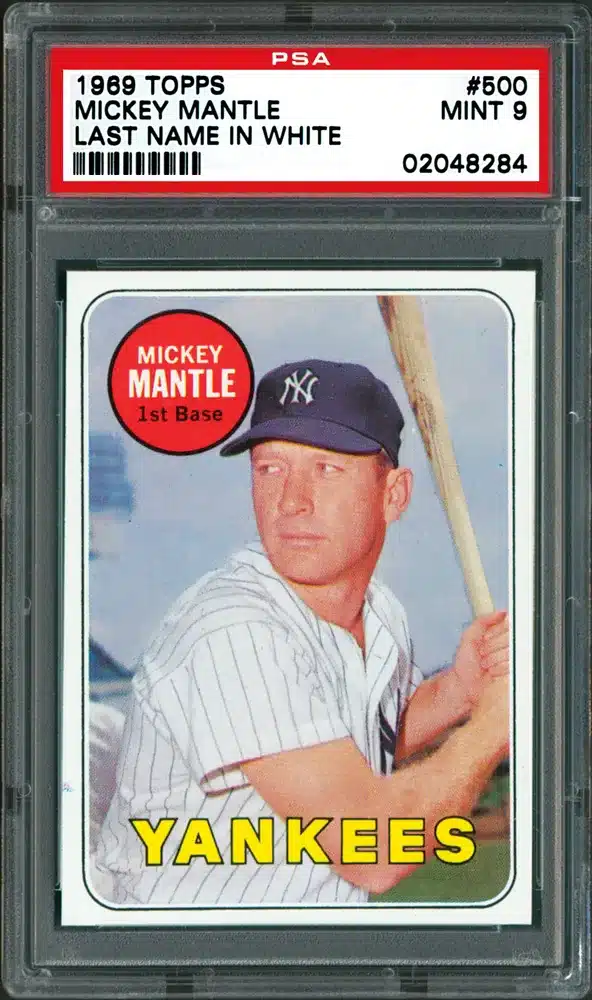
Topps continued to feature Mantle throughout the 1960s, including cards from his later years like the 1968 Topps #280 and 1969 Topps #500. These cards can be a more accessible way to own a vintage Mantle, especially in lower grades, and they capture different eras of his career.
What Determines the Value of a Mickey Mantle Baseball Card
Two Mantle cards from the same year can sell for wildly different amounts. Here is what moves the needle.
Year and set. The earlier and more historically significant the card, the higher the price. A 1951 or 1952 card will almost always cost far more than a similar-condition card from the 1960s.
Condition and grade. This is the biggest factor of all. A card that looks great at first glance might still have soft corners, surface wear, or centering problems that reduce its grade. The gap between a mid-grade card and a gem mint example can be enormous.
Eye appeal. Collectors often pay a premium for cards with strong color, sharp focus, and balanced centering, even when two cards share the same numeric grade.
Authentication and the grading company. Cards graded by respected third-party services such as PSA, SGC, Beckett (BGS), and CGC tend to attract more buyer confidence. Different holders and grades can influence resale value, so look at past sales for the exact company and grade you are considering.
Market conditions. Prices respond to auction results, economic trends, and collector sentiment. Mantle cards have been remarkably resilient over time, but no card is immune to market swings.
Understanding Grading for Mantle Cards
Because vintage Mantle cards are valuable and frequently handled, professional grading is a cornerstone of the market. A grading company authenticates the card, evaluates its condition on a numeric scale, and encapsulates it in a tamper-evident holder.
For Mantle cards, grading provides three key benefits:
- Confidence in authenticity. Counterfeits and reprints exist, and a trusted grading company helps confirm what you are buying.
- Transparent condition. A grade offers a standard language for comparing cards.
- Easier resale. Graded Mantles are typically easier to price, list, and sell.
It is also important to know that some cards come back from grading labeled as altered or otherwise not receiving a numeric grade. That usually means the card has been trimmed, recolored, or otherwise modified. Avoid these unless you are knowingly buying one at a steep discount.
How to Avoid Fakes, Reprints, and Altered Cards
Mantle is one of the most counterfeited players in the hobby for a simple reason: the payoff is large. Protect yourself with these habits.
- Buy from established sellers. Choose dealers and auction houses with strong reputations and clear return policies.
- Favor authenticated cards. A card in a reputable grading holder removes much of the guesswork. Always verify the certification number online.
- Be skeptical of bargains. If a deal on a vintage Mantle feels too good to be true, it almost certainly is.
- Know the reprints. Topps and other companies have issued reprints and tribute cards over the years. These are legitimate collectibles in their own right, but they should be clearly identified and priced accordingly.
- Watch for trimming and restoration. Sharp, perfectly straight edges on a card from the 1950s can sometimes signal that it has been trimmed. When in doubt, get a second opinion.
Buying a Mickey Mantle Baseball Card on Any Budget
You do not need a seven-figure budget to own a piece of Mantle history. A practical way to think about it:
Entry level. Look at 1960s Topps cards in lower grades, or consider modern tribute and reprint cards that honor Mantle without the vintage price tag. Make sure any reprint is clearly labeled.
Mid-range. Mid-1950s Topps cards in lower to mid grades are a popular target. A well-centered card with good color can look fantastic in a display case.
High-end. Early 1950s Topps and Bowman cards, particularly in higher grades, are where serious collectors compete. At this level, authentication and provenance are especially important.
Whatever your budget, a few rules apply. Buy the best card you can comfortably afford, compare recent sold prices instead of asking prices, and choose a card you will enjoy owning. The best collections are built on passion.
Frequently Asked Questions About Mickey Mantle Baseball Cards
What is Mickey Mantle’s rookie card? There is considerable debate over whether the 1951 Bowman is the true rookie card versus the 1952 Topps #311, though both have their case to be called rookie cards. If you find yourself in a debate with another passionate collector, be prepared to defend your position!
What is the most valuable Mickey Mantle baseball card? The 1952 Topps #311 in high grade is generally considered the most valuable. A high-grade copy sold for roughly $12.6 million in 2022.
Are Mickey Mantle cards a good investment? Mantle cards have a long record of strong demand, but prices can rise and fall and no card is a guaranteed investment. Collect what you love and do your research.
Should I buy raw or graded? For valuable vintage Mantle cards, graded and authenticated examples are generally the safer choice. Raw cards can be a budget-friendly option if you know what to look for.
Where can I buy an authentic Mickey Mantle baseball card? Stick with reputable dealers, auction houses, and cards authenticated by major grading companies.
Start Your Mickey Mantle Collection at Boston Card Exchange
A Mickey Mantle baseball card is more than a collectible. It is a piece of baseball history and a direct link to one of the game’s most beloved legends. Whether you are chasing a 1952 Topps or starting with a 1960s favorite, the formula is the same: learn the key issues, prioritize authenticity, and buy with confidence.
Ready to find your next piece of the Mick? Browse our inventory at Boston Card Exchange, and reach out if you have questions about condition, grading, or building a Mantle collection that fits your budget.