Rare Baseball Cards: What Makes a Card Rare and How to Spot One in Your Collection
Rare baseball cards are cards with very few surviving copies. They are usually pre-war issues, short prints, error cards, or high-grade survivors. Rarity alone doesn’t make a card valuable, though. A scarce card of a forgotten player can sit quietly, while a scarce card of a legend can bring millions.
Knowing which kind of rare you’re dealing with is the key. Here’s how collectors tell the difference.
What Makes Baseball Cards Rare?
Low Survival Rates
Early cards were packed in cigarette packs and candy boxes, and most kids treated them as disposable. Many were thrown away, flipped, or put in bicycle spokes. Cards that survived 100 years are scarce simply because so few were saved.
Errors and Short Prints
Sometimes a mistake makes a card rare. In the T206 set, Sherry Magee’s name was misspelled “Magie.” The error was caught quickly, so few copies reached collectors. Short prints, meaning cards printed in smaller numbers than others in a set, work the same way.
Condition Rarity
A card can be fairly common but extremely rare in top condition. Sharp corners, strong centering, and clean surfaces are hard to find on 70-year-old cardboard. Our guide to grading vintage baseball cards explains how condition is judged.
Famous Examples of Rare Baseball Cards
T206 Honus Wagner (1909–11)
Only an estimated 50 to 60 copies are known. Wagner objected to his card being included in cigarette packs, and production stopped. One example sold for $7.25 million in 2022, and a copy that had been in one family for 116 years sold for $5.124 million in February 2026.
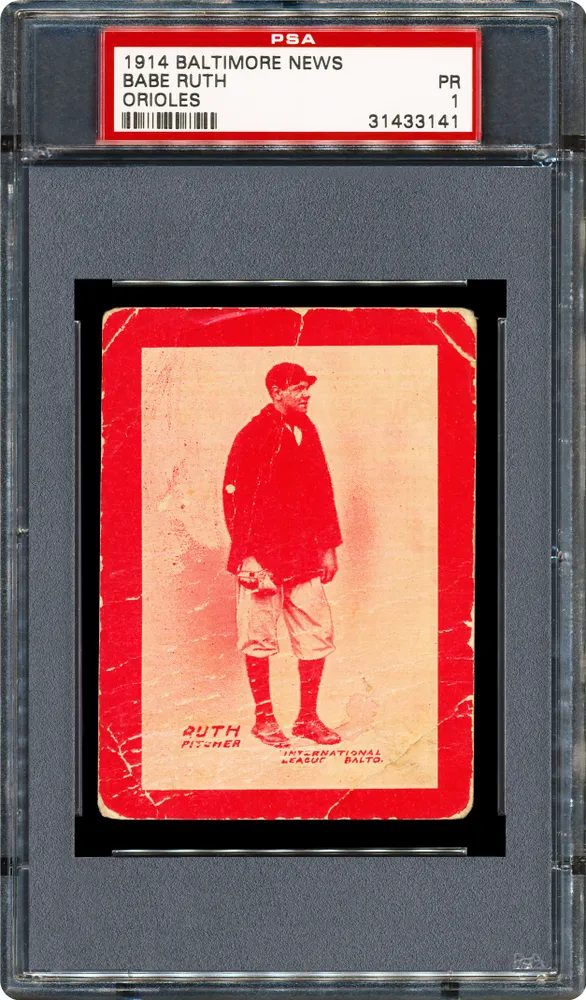
1914 Baltimore News Babe Ruth
This is a 19-year-old Ruth pitching for the minor-league Baltimore Orioles. Roughly ten copies are known. An SGC 3 example sold for $7.2 million in December 2023, a record for a Ruth card.
1952 Topps Mickey Mantle
This card isn’t scarce in numbers, but it’s scarce in condition. An SGC 9.5 copy described as the finest known sold for $12.6 million in 2022, the highest price ever paid for a sports card at that point.
The story behind it is a reminder to look carefully at old boxes. A Boston-area man who had inherited a large stash of mint 1952 Topps cards sold about 5,500 of them to a New Jersey dealer for $125,000. That Mantle was among them.
How to Tell If You Have Rare Baseball Cards
You don’t need to be an expert to do a first pass.
- Check the year and set. Pre-war tobacco and candy cards deserve a careful look.
- Look for stars and rookies. Hall of Famers and first-year cards are where demand concentrates.
- Read the card closely. Misspelled names, odd borders, and unusual backs can signal an error or variation.
- Judge condition honestly. Corners, edges, creases, and centering all matter.
- Beware of reprints. Reproductions of famous cards exist, and genuine examples of the very rarest cards are, by definition, extremely scarce.
For a deeper look at how age, scarcity, and demand shape pricing, see our guide to vintage baseball card prices.
What to Do If You Think You’ve Found a Rare Card
A few simple habits protect value:
- Don’t clean, flatten, or “fix” it. Alteration can erase value.
- Handle by the edges and keep the card in a soft sleeve.
- Store it flat in a cool, dry place. Attics and damp basements are risky.
- Photograph both sides in good light.
- Keep the whole collection together until it’s been reviewed. A card that looks ordinary can sit next to one that isn’t.
Rare Baseball Cards: Frequently Asked Questions
What is the rarest baseball card?
It depends how you measure it. The T206 Honus Wagner (an estimated 50 to 60 copies) and the 1914 Baltimore News Babe Ruth (roughly ten known) are among the scarcest. The most expensive one sold is the 1952 Topps Mantle, which is rare in top condition rather than in total numbers.
Is every old baseball card rare?
No. Old doesn’t automatically mean rare. Some older sets were printed in large numbers, and condition has a big effect on how scarce a card really is.
Are error cards always worth more?
Not always. An error can add value when collectors want the card, but the player, the set, and the condition still matter. Misspelled names like the T206 “Magie” are classic examples collectors look for.
How can I tell if a rare card is genuine?
Compare it carefully with known examples and be wary of anything that looks too good to be true. Reprints and altered cards exist, which is why authentication matters for any card of this caliber.
Have Rare Baseball Cards You’d Like Reviewed?
Boston Card Exchange specializes in buying baseball card collections, especially vintage. If you’ve inherited a collection, found old cards in the attic, or are thinking about parting with yours, we’d love to take a look. No collection is too large or too small.
Our complete guide to selling your baseball card collection explains how the process works. When you’re ready, get in touch with us here.